

Las Vegas has never quite managed to get its game together when it comes to mass transit.
The latest case in point: Steve Hill, CEO of the Las Vegas Convention and Visitors Authority, confirmed last week that the Las Vegas Monorail's pylons and track will be repurposed as aboveground vehicular roadways for the Boring Company’s Vegas Loop, owned by Elon Musk.
"The Vegas Loop makes a huge difference whether you’re using it or not in taking people off the streets,” Hill said in a speech to the Southern Nevada Home Builders Association, according to the Las Vegas Advisor.
That would be news to residents and visitors who currently drive on Paradise Road. The Vegas Loop has added cars to that street rather than taking them away, with drivers competing for space with Boring Company Teslas on aboveground public streets, even though the Loop was billed as a subterranean alternative to vehicular congestion.
Of the plans for the monorail, Hill said: “We’ll take the track off, put a pre-cast two-lane road on top, incorporate it into the Boring Company system, and use the existing Monorail stations. When you get to the MGM station, we'll tie it into the parking garage and use it as part of a station with ramps to get in and out of it."
That would seem to put the last nail in the coffin for the financially and operationally challenged Vegas Monorail system, which runs 3.9 miles across seven stations along the east side of the Strip from the Sahara hotel and casino to MGM Grand.
Originally opened in 1995 and expanded to its current form in 2004, the Las Vegas Monorail was purchased out of bankruptcy for $24 million in 2020 by Hill's organization, which is the city's official tourism marketing agency.
In 2024, Hill touted the monorail's “great” financial performance to local news reporters. “Ridership is up," he said. "We've gone from what used to be a little less than 5 million people a year to about 6 million people a year.”
But the tourism organization has sent mixed signals about the monorail's future. The agency has so far committed $12 million in active investment to keep the monorail operational until at least 2035. But Hill has been tossing around the idea of a handover of the infrastructure to Musk since at least 2024.
The monorail has long been the subject of mockery in Vegas. But it has been a genuine—if small—effort toward providing affordable, convenient, city-worthy mass rail transit in a tourist corridor where the majority of visitors are traveling up and down a flat, linear 4-mile path.
Now the city is giving up and doubling down on Musk’s roadways instead.
What is the Vegas Loop?
Let's start with what it's not. It's not what was originally proposed.
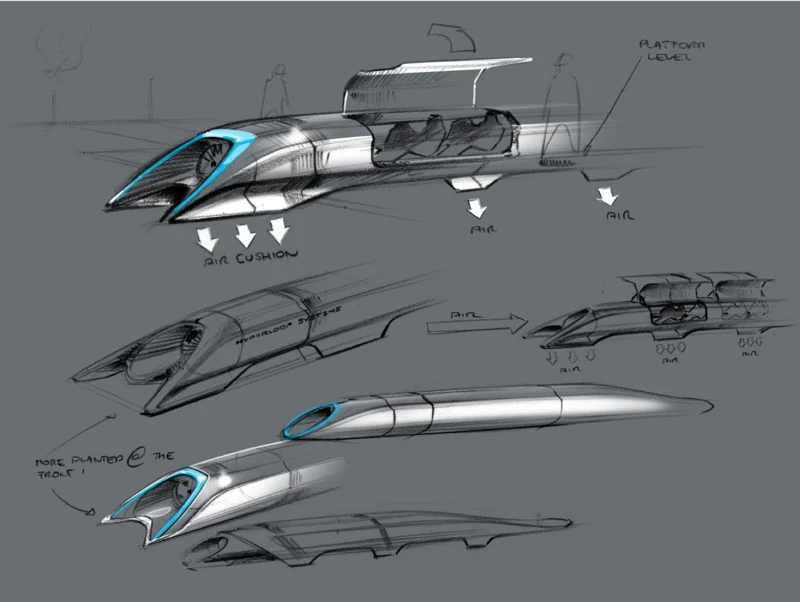
Elon Musk’s initial pitch, back in 2013, was for a “Hyperloop” of futuristic pods rocketing between cities in pressurized tubes “at over 700 mph.”
The company engaged in a nationwide blitz of lobbying and marketing, promoting a razzle-dazzle sci-fi transportation solution to cities like Los Angeles, Fort Lauderdale, San Antonio, Miami, and Chicago, among others, domestic and abroad.
In most cases, those Boring Company projects have stalled or been abandoned. But Las Vegas decided to go all in despite mounting evidence that the proposals might not pan out.
What Musk and the Boring Company were ultimately able to deliver to Las Vegas in June 2021 was . . . sedans. In shockingly narrow single-lane tunnels. Driven by humans. At speeds around 35 mph.

Bloomberg referred to the $49 million delivered product as “more marketing flash than public transit.”
We’ve ridden the thing, and can confirm it’s not beating the allegations of being unserious, unscalable, and cost-ineffective.
To get to the airport, for example, Loop passengers board Teslas from select casino resorts, passing through Musk's tunnels for about a minute before taking an exit for a regular, old-fashioned road the rest of the way. Not exactly a mind-blowing glimpse into the future.
In the 5 years since launching the Loop, the Boring Company has only managed to expand the system to a few miles with nine stations—five of which are located within the same building, the Las Vegas Convention Center.
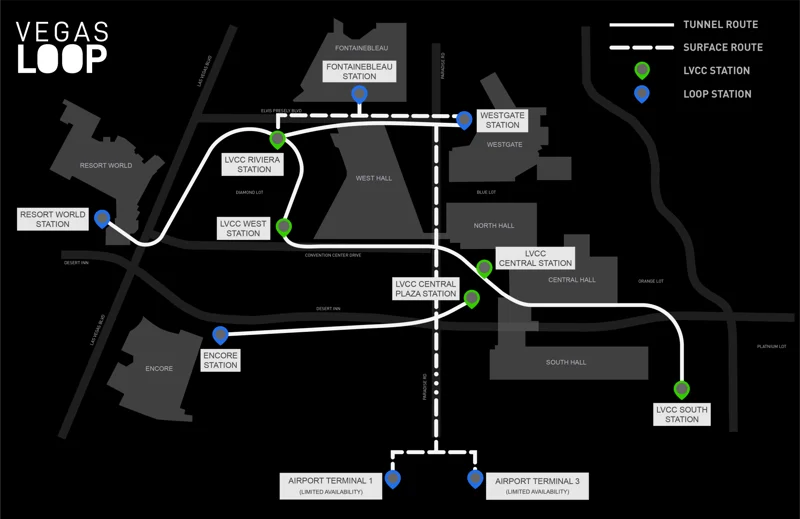
Single-ride fares vary between $5 and $12 with routes both below- and aboveground now mingling in the same traffic congestion the Vegas Loop was ostensibly built to avoid.
The Boring Company, on its official site, compares the Loop to high-volume subway systems like those in New York, Chicago, and Los Angeles, alongside dubious claims of the Vegas tunnels' superiority.
“If a subway line had 100 stops, a train would typically stop at each station, so the trip between Stop 1 and Stop 100 would be long,” reads the Boring Company website. “In contrast, Loop passengers travel directly to their destination, anywhere between Stop 1 to Stop 100, without stopping at the intermediate stations.”
Mind you, subway systems like New York City's have proven efficient and convenient enough to accommodate millions of people per day, rather than the far more limited total you can cram into a fleet of Teslas. And, unlike the Boring Company’s Loop, the subway usually doesn’t require waiting for oncoming vehicles to clear one-way tunnels so that your ride can resume.
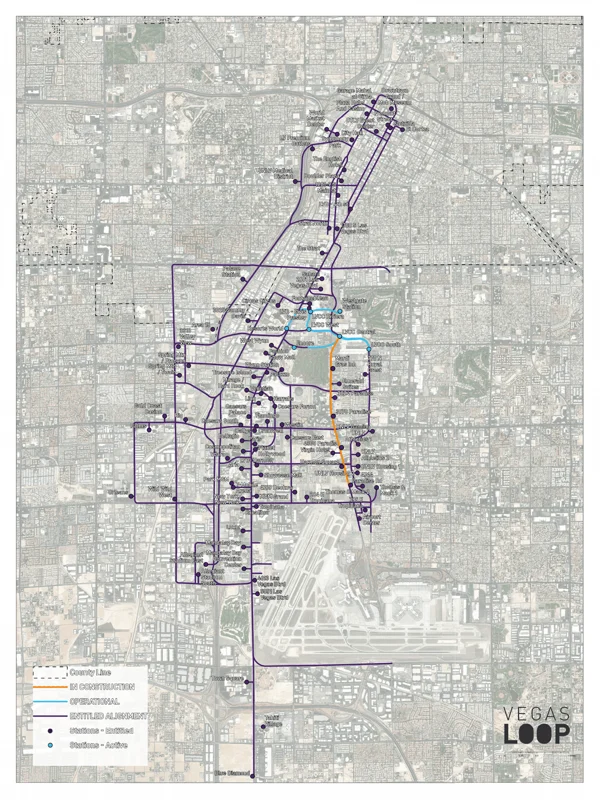
Still, that hasn’t stopped Las Vegas and the Boring Company from charging ahead toward a goal of 68 miles of tunnel and 104 stations, “cementing the Vegas Loop as a vital piece of the city's future infrastructure," claims the Boring Company.
Vegas isn't alone in taking a big gamble on Musk, either.
Both Nashville and Dubai Loops—or parts of them, anyway—will be burrowing their way under those cities soon.